Pages

Showing posts with label music. Show all posts

Saturday, 12 October 2013

In Utero: 20 Years Later

The greatest moment for me listening to In Utero again in it's 20th anniversary form didn't even have anything to do with the new and remastered music, but was the moment of realization that 20 years was the amount of time it's took to stop In Utero from being a Kurt Cobain suicide note, a Nirvana sign-off or just a deeply depressing disk seen only through the veil of a shotgun-fueled tragedy that occurred months after the albums release. In Utero, both because of the 20 on it's box and the extra material, which leads into alternate cuts, outtakes and live performances, has finally become just another Nirvana album; a piece of the furniture. Most discs wouldn't survive being taken out of their place of importance or innovation or cultural relevance, but In Utero does because it has the thing that made Nirvana so great, and it has it in spades: that unassuming quality, the delivery of great rock music with no fake importance, painful levels of emotion without the need for an excessive production. 

Yet the biggest praise normally leveled to Utero is that it sidestepped the major commercial success of their previous album Nevermind and actually reversed Nirvana back somewhat, away from the mainstream and into a much more raw, darker place that would make more sense alongside the obscure Seattle grundge rockers that Nirvana's success had left behind. Yet this is partly untrue; Nirvana did deliver an album almost purposely aimed away from the mainstream, but they in no way managed to escape the shadow of their success; everything from this albums first line ("teenage angst has paid off well, now I'm bored and old" - which here returns back to it's original sarcastic quip, and not the dark self-contradiction it could be seen as) to it's mainstream-crushing song titles (Radio Friendly Unit Shifter is the antithesis of a mainstream seller) all meant as a response to the band's success, which this whole album is; a darker, more personal, less clean response to an album that was squeaky and shiny and ironically the furthest Nirvana ever went from their signature sound. 

And as an album on it's own, forgetting the personal and commercial implications, In Utero has always been a masterpiece, dark and personal for sure, but in musical terms a fast and angry punk-rock release; no remastering required. Which is why it's thankful the remaster has no resemblance to the lifeless remastering of Nevermind from two years back. Not that your stepping into a completely re-organized land of clarity, but this disc updates the original disc without stripping any of the personality out, and on top of that there's a "2013 mix" of each track, produced by original composer Steve Albini, that adds some slight differences to each song. The word slight should be kept in mind; the 2013 mixes don't have any jarring changes, not at all jarring enough to change anyone's opinions of these tracks, and probably un-noticeable completely to the un-Nirvana-trained ear.  

Better than that is the entire "MTV: Live and Loud" performance from 1993. I caught most of it on Youtube around a year ago, and listening here without the stage persona, the impressively lively one that Nirvana had, to look at, does weaken things a little; but it's made up for with the great sound quality and some recordings which apparently never aired on TV. I'll stand by my assertion that the live versions of "Radio Friendly Unit Shifter" and "Scentless Apprentice" are better than the album versions; the lyrics are actually understandable and Cobain's gargled singing (and screaming) become less threatening. The highlight of Live and Loud though is a cover of David Bowie's "The Man Who Sold the World", there's already the acoustic version from Unplugged in New York, that has over time become more popular than the Bowie original, which is still the more impressive version, but the version presented here is a faster rock n roll version; and to compare the two is to see the two very different opposing sides of Nirvana. 
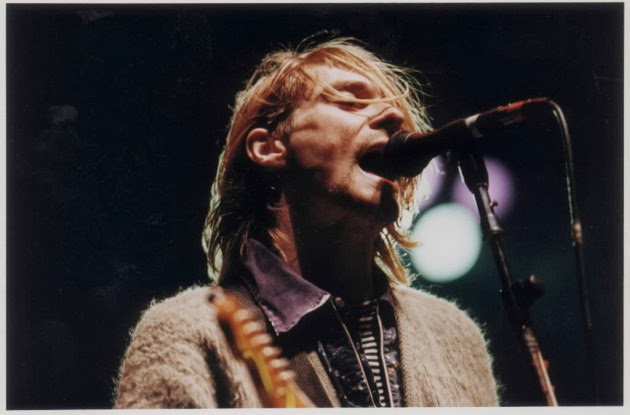

And now for the real draw; the unreleased material. It was with these that I started to see In Utero in a different light. These recordings take In Utero out of the weird underworld it has always been heard, that spectral world from the Heart Shaped Box video filled with broken hymens and biblical illusions, and takes us straight into the studio it was recorded in. Which was itself a fiery two weeks of recording; probably filled with recording sessions as claustrophobic as many of the tracks found here. The highlight for me was "Gallons of Rubbing Alcohol Flow Through the Strip" a track originally promised on my CD copy of In Utero as a "Europe only track" that my copy still never played. At 7:35 it comes in as the longest track in the Nirvana cataloge; the first half takes you into Cobain's parental fears, in all his screeching lyrical glory, but in the end it's hard to truly believe this track is any more than a part-sarcastic wink at his own personal troubles, confirmed by the second half of the track which is a rambling jam session, including Cobain confirming there's "one more solo" and heavy guitar feedback. And it's strange to hear this messy Nirvana for the first time; because for all the talk of slackers and greasy hair Nirvana wear always well-practiced and the unceremonious length of all their other tracks is testament to unacknowledged professionalism. It's a sad song really, taking you so close to the band members, and to someone the world left back in 1994, but it didn't stop me from listening again and again. 

The rest of the recordings are no long lost treasure chest but they further illuminate some of the more messy sides of Nirvana; "Marigold" sees Dave Grohl preparing for Foo Fighters with what I imagine is his first recorded vocal performance. A live Foo Fighters version recorded around 15 years later is available, and like everything Nirvana-Foo it's the tidy, well executed and mostly emotionless ying to Nirvana's darker, more haunting yang. Not to pick sides, or even write about something that's pointless and needing of much more space than it would get here, especially when Grohl's enthusiastic rock is a joy Nirvana never gave out, but I've always prefered the older band; and the emotion poured into the final In Utero, along with willingness to go further out into places no-one knew they were even think about in these back-stage recordings, is my quickest way to explain why, and it's all their in "marigold" for you to see. 

"I Hate Myself and Want To Die" pulls no punches; no explanation, no sarcasm, it's actually all nonsense to the point that it's title line is never even mentioned. It fits the muddled sound of the album, punctuated by a catchy hook, and was probably dropped more for it's name than any tonal flaws. It originally shared the name of the album before Krist Novelistic persuaded Cobain they were only headed for a lawsuit with that one. Strangely absent from the set list is "Verse Chorus Verse", youtube available, that was also an early album title, and adds to the themes of artistic boredom and personal anguish, but for some reason was not felt worthy of mention here. And yeah, there's other stuff too, there's an instrumental track and a even some demo's, one's called "Jam" although I still can't - even after two or three listens - remember anything about it. You'll gloss over most of it; even a lot of the good stuff, because surely the 2013 mixes are pointless and the live show deserves a separate listening sesh, no: this collection is an excuse to return to a great album, itself expanded by some extra tracks. 

And this one's always been my favorite Nirvana disc. Nirvana's discography has always made me stop and stare; the three discs they released, the same two year gaps between each, and the emotional turmoil and changing living arrangements of everybody involved during these three releases all comes across as a perfect beginning, middle and end story. An amateurish garage record that received little success, a mammoth pop record that shot into superstardum, and this, a darkly personal record that went further into both blues and metal, and even had time for their acoustic ready-side ("All Apologies" just makes sense as the final Nirvana track on their final album) and even without the same commercial success has became the band's most loved album. 

And the album itself: it's a fun record. The lyrics are simpler and less straddled with the great weight they're thought to have, but they do have meaning, however obscure, and represent Cobain's greatest moment as writer; from the scope of disturbed imagery created ("Meat-eating orchids forgive no one just yet/Cut myself on angel hair and baby's breath") or the softer moments savored for things more thoughtful  ("Give me a Leonard Cohen afterworld/So I can sigh eternally"). It's up to you entirely if you want to add some meaning to a song as blunt as "Rape Me", lots of fans do, some see it as a song about isolation, while other's see it's similar cords to Teen Spirit as a joke on artistic rape by the mainstream; it's far fetched but believable, although meaning or not it's still an obvious call for controversy, smartly done at least.

The actual sound of the album is very aggressive; the opening guitar riffs on "Very Ape" literally rip through the air molecules as you burst into the song which feels like an explosion of inner turmoil, all done in less than two minutes. It's not exactly punk; it's more structured and thoughtful than anything Nirvana had done previous, and songs like "Dumb", while not exactly slowing things down, do provide a more identifiable image of the emotions flying around. Each track tries to do something completely different from all the others yet when you get to the end it feels like a well rounded experience. Yet it's really the flaws that make this album. Some might find that strange, but have you ever listened to an album and simply went with every song there? Good maybe, but boring, and not much of a challenge for the ears. "Tourette's" is heavier than Metallica, and a lot more scary, and I've already mentioned the gargled lyrics and violent screaming on some tracks just come on too strong, but all these tracks really feel like they're going for something, pushing against each other with jagged edges; you wouldn't be expected to like it all. In the end it's just good music, simple as. 

And that's really all there is to say. Go listen and enjoy. In Utero has always been tagged as the Nirvana album people who don't like Nirvana like, and the extras are only a support act to that. And it's an even better thought that people would discover the band, or at least the album, in this form. 


(I'm going to stop giving a rating in my reviews from now on, it's always felt pointless giving them out so I'd rather just let the review speak for itself)

Wednesday, 11 September 2013

Arctic Monkey's AM Review

Mad Sounds, from the new Arctic Monkeys album AM, their fifth, is a Velvet Underground song that's had a trip around Electric Ladyland; by which I mean it's a slow and at times mournful song that ends up being inspiring through it's hints of romanticism. It's Stephanie Says with a groove. The album's name might just be the band's initials but it makes much more sense as a reference to the early hours of the morning; the parties over but the beats are still bouncing around your head. The production reflects this, it has the thicker sound of Humbug, their part-psychedelic and all too slow third album, while keeping the faster pace and personality of their early albums.

Which is to say it has so far been impossible to tell if each new Monkeys album heralds a new piece of musical evolution or just shows us another side of the same band. Their last album Suck It and See ditched the forward trajectory they were on; getting slower and more attuned to studio manipulation, and instead focused on a more raw sound and took Turner's lyrics back to finding the exciting in everyday mundanity. So the most impressive thing about AM is that it finally sums up the band. It fits in all sides of the group; the fast songs still manage to be soothing and the slow songs still have a beat. The whole album has a unified sound that finally confirms that the Arctic Monkeys have moved on from the past, all the while putting together the best track list since their debut.

Like a sudden jolt to the system we're welcomed to the album with the drum beat of Do I Wanna Know? Turner's lyrics come very fast; they remind me of The Rolling Stones, think 19th Nervous Breakdown, and both remind me less of rock lyrics and more of rappers; words, all rhyming, all coming at you fast. Do I Wanna Know? is a great rock song that works just as well as a party tune. The album starts off with it's fastest tracks, eventually slowing down for the aforementioned Mad Sounds and No. 1 Party Anthem, which feels like the loneliest dance floor in the world until Turner's "Come on, come on come, before the moments gone, number 1 party anthem" which sounds like a gleaming ray of hope and energy injected into a deadened night club; just like the rest of the album this song could easily fall into depression-filled plodding but instead I couldn't stop listening; it aims for the dance-floor but there's still something to return to when the party's over.
And eventually we stagger through the night into I Wanna Be Yours. It was originally a poem by John Cooper Clarke, with the song version having some tweaks from Turner. It sounds like a journey well-traveled; the ending is filled with infinite possibilities. It brings forth that feeling of coming home late after a great night out. All wrapped in poetics that are perfectly tuned to Turner ("Let me be your 'leccy meter, and I'll never run out, let me be the portable heater, that you’ll get cold without"). It ends an album that is, like the Monkey's debut, much better when heard as a whole; a by-product of an album where all the songs aim for the same thing, on first listen you may not even remember which track is which, but it doesn't matter because if you want variety just go fishing through their back cataloge; AM takes you into it's own headspace and doesn't let you go, and it's all the better for it.

There's nothing to prove on this album either; which isn't meant as a criticism. The bands guitar is there to be admired but never takes over the song, it neatly folds into the production. And Turner's lyrics go through their biggest change, possibly brought on by his move to America, in which he looks away from the smaller details and happenings of everyday life and instead writes an album filled with poetic metaphors and the longings for love: "It's an exploration, she's made of outer space/and her lips are like the galaxy's edge/ and her kiss the colour of a constellation falling into place". There's a Hendrix-esque mystique in the otherworldly-ness of the lyrics on AM.

Yet when reaching such highs it makes it worse when you come crashing down; which the latter part of AM does. There's some filler here; Knee Socks and Snap Out of It being the main culprits. I have mixed feelings towards recently released single Why'd You Only Call Me When You're High? It represents the style of the album perfectly; once again it starts with a drum beat that leads into a slowed-down hip-hop sound and keeps accelerating throughout. But the chorus blurs into the verse and by then this same sound just feels like a drag compared to other tracks on the album. I hope the Monkey's don't tag this "their style" as if to say they'll stay on this path from now on, but for what it is AM is my favorite Arctic Monkeys album to date, and a great surprise following their weakest album. 9/10

Thursday, 29 August 2013

My Life in Music

So I finally find a page on the internet where my writing seems needed, because who doesn't want my entire musical life mapped out in front of them? And those uptight bastards over at Pitchfork have made it an exclusive club; turns out I need to become famous before they let me in. Go give them some page hits anyway. But what are blogs for but ultimate self delusion; so here's my musical life mapped out in the style of Pitchfork's 5-10-15-20 series, only with a slight bit of tweaking due to age restrictions. So don't worry if the below numbers don't seem to be actual stages of life but a random assortment of dates plucked out of the air for writing convenience: because that's exactly what they are.

Party like it's 1999
So 1999 sucked for music? I was too busy turning 3 at the time to notice. Forgive me, I'm not completely sure if this adds up; do children start to form actual proper thoughts at three years old? We'll say they do. A few years ago at school I was asked to sum up my childhood. I simply replied "Abba and trains". I did like trains, and I can remember being pretty knowledgeable on them to; I just don't remember the actual knowledge. I do remember Abba though. Apparently my grandma bought every Abba LP that was released during their hey-day (the 70s) and since I spent a good chunk of my childhood with my grandparents I subconsciously took it all in. I still put Abba on now and again, it's my ultimate source of nostalgia. I can't imagine a more childhood-orientated band. No drugs swindles or messy break-up; everything behind doors was as clean as the music. I always associate them with The Beatles: Abba are like the fab four of the 70s, by which I mean a family friendly mainstream pop act who because of their picturesque view of everything gave me a very optimistic view of the past, and what other band, or living entity in general does that?

"You can dance, you can jive, having the time of your life/ See that girl, watch that scene, diggin' the dancing queen"

Pre 9/11 Music 
I always wonder which music my generation will call our own. We're too young to claim music from 2000 and 2001, yet there's an era of music from then that no generation seems to want. The 90s were easy to call; everything segregated by different musical "movements": there was the Nirvana-Pearl Jam grundge movement of the early 90s, then there was Oasis and Blur blazing through Brit-pop in the middle of the decade, and the end of the decade was some juvenile punk/millenium angst bullshit. Lots of S Club 7 cheese floating around; enough to cause a backlash from Radiohead-types who took a more pessimistic look into the future. But my earliest memories of listening to music that was actually just releasing at that moment is the feel-good hip-hop and R'n'B wave of the early noughties. Surely Outkast's 'Hey Ya' is the national anthem of this time. It's not that 9/11 made all music serious, only people stopped tolerating songs that gave out feel-good messages. If the 90s was a feel-good decade; no wars or global warming or recession, all music and movies let people just drift into fantasies; over the top Michael Bay cartoons and Tarantino pulp fictions, then everyone spent the noughties listening to music that was to supposedly remind them of the real world. Lots of political messages and big issue songs, and lots of movies about war and internal struggle. So this early noughties music is my glowing view of innocent childhood. It's was all about the groove and getting high; what other time could have produced hits like Afroman's 'Because I Got High' and R. Kelly's 'Ignition Remix'. It's like people were celebrating the lack of any 1999 apocalypse. This music exists solely unto itself; simple tunes from people who were just making their way; after that no-one believed in anything but second-guessing and being a smart ass. I'll very happily claim this era as my generations music.

"Uh, thank god for mom and dad/For sticking two together/Cause we don't know how"

(Early) Teen Angst: 2004
I listen to Smells like Teen Spirit over and over. I try and unload it onto every poor sap who will listen. The speakers on my computer break and I'm testing them out, put it to full volume although it still doesn't work, then finally get them on and it's blasting full volume through the house. Wakes my mother up. Yet that's the only way to play that song; extremely loud. If you don't it just sounds like the last 20 years, the 20 years since it's release, of boring mainstream rock that owes nothing to any song but this one. I don't even like that song anymore; ever eaten the same cereal everyday until you think if you eat it again tomorrow you'll be sick? That. My dad had Lithium on the computer too so I listened one day and hated it. But I spent a day at school with the tune ringing through my ears. So I decided to listen to their greatest hits; it's the only Nirvana CD my dad has; it's on the shelf in the living were we used to keep a big CD collection; just like the movies and games on this shelf I look through all of them not knowing what they are. I did never listen to more than half of those CDs but those I did listen to went somewhat into shaping my musical tastes. So I'm listening to the greatest hits and apart from Teen Spirit and Lithium I hate every song. What a terrible band. But like Lithium I keep listening to every track, eventually I like all of them. My uncle gives me Nevermind. I still haven't given that back. Before I was 10 I must have had all Nirvana albums: and I mean ALL of them. Not just the studio albums: the compilation albums, the live albums, everything. Needless to say they're my favorite band I can pinpoint this early moment as probably the most important in forming my musical tastes. I thought I was some sort of connoisseur in grundge music despite not listening to any other grundge bands: Alice in Chains was far too scary and I had never even heard of Pearl Jam. I was now officially a fan of rock music.

Yet I still wonder why I went for Nirvana. You can almost spot Nirvana fans; I took guitar lessons in middle school and the Nirvana fan there was a girl who I remember for wearing all black and looking like the definition of rebellion. I don't think someone could point me out as a fan of Nirvana or for that general vibe. I was actually pretty popular at school when younger. Now I'm more an outcast. Because y'now, people: what a load of fuckers. But thinking back I don't have the same lonely-and-bullied-kid-seeking-solace-in-kurt-cobain sob story that most have; I just liked the music.

"I found it hard, it was hard to find/oh well, whatever, nevermind"

2006: Rock & Roll is back? 
To give some clues as to pinpointing the exact date we're talking here; on my Limewire playlist, the service I used at the time to download vast amounts of illegal music, had on it a song called 'scummy'. When this song was released as a single, where it became a big hit, it was renamed to 'When The Sun Goes Down' and confirmed the rise of the Arctic Monkeys; the first band recent enough for me to follow from the start. They're the best band of this time, for the most part lacking the same generic nature that I hate about most other modern bands. Their music would fit in with almost any era of rock. When they first appeared they were a unique creation; a combination of Alex Turner's London-rapist style lyrics and very punk learning-it-as-we-go guitar work.

Another band, maybe not as respected, but no less important to me, is Nickelback. They really have went downhill lately haven't they? You say you don't know, that you've never given a band like Shitelback enough thought to actually ponder any ups and downs the band might have went through. Well as someone who was very proud to tell of my love for Nickelback (Cringe) I can tell you full well that yes they have went downhill. They've went so far downhill they've plunged straight-through the ground, straight past Coldplay (used to like them too) and are plummeting straight for the center of the earth. Hopefully it's uninhabitable. But that does show that at one point they were flying high; like all 21st century bands they have done no experimentation or brought us any innovations and they have kept that misogynistic rockstar pose that everyone thought was banished away in the 90s (so much for forward progress) but when they weren't sucking up to the mainstream they gave me my childhood template for modern rock. Which meant lashings of 'How You Remind Me' and 'Rockstar' on endless repeat.

My opinion of this moment in rock is like two opposing forces pushing against each-other. Looking at it as a wisdomous music critic I must say this music is horrifically bland. Following on from the three-cord rock of the 90s and inspired by the simplistic tunes of Nirvana, this rock is recycled from the past but without any of the emotion or inspiration which made those older bands so good. But, but... ah fuck it; I love this music. Or at least it has a glowing halo above it's head protecting it from any negativity I might throw it's way. I grew up buying albums by Red Hit Chili Peppers, Snow Patrol, The Kooks, Foo Fighters and Keane; most represent a misdirection from 90s which was all about dark emotions and self-indulgence; this music is all meant to appeal to the mainstream, to be played in stadiums and fit the standard bill of what "rock music" is; by which I mean none of the people involved in these bands were of the Jim Morrison drugs-sex-rock-n-roll ilk of rockstars, they either pretended they were or just buckled up and stayed clean. Not exactly a bad thing, but most likely the reason for my determination to find bands that acted the complete opposite.

"And what a scummy man/Just give him half a chance
I bet he'll rob you if he can/Can see it in his eyes,
Yeah, that he's got a driving ban/Amongst some other offences"

The Spotify Years (2009 and onward...)
I know I'm supposed to be keeping it in the generation but it was my granddad who discovered Spotify. Reading all these PC magazines he found it before it was cool (Which makes it better, right?) and I got sucked in. So my musical discoveries have been mostly a muddle since then. Only they partly haven't since during these years I was said to hate older music, was said to have heard a Beatles album at a family get-together and exclaimed all their songs sounds the same, and thought of my inkling with bands like Alice in Chains and songs which I would classify as "vietnam music" as making me a far stretching man of music. It's strange to think of this time because even though I took ever chance to cut it down; I listened to as much modern pop as I did rock. And few pieces of older music.

Which makes this the only era in which I can properly report on the modern music of the time. This was when music stopped sounding enhanced by machines and just started sounding like machines. Trademarks of this era include songs which ended with a high pitched "Jasoooooooon Derulooooooooo" just to make sure you knew who was singing, incase y'know, MTV forget to put the titles up or something; the beginning of modern artists trying to seem down with the moment, usually by utilizing twitter, internet speak and very poor dance moves; and lots of women, all apparently inspired by Madonna and Britney Spears (If only people could take other sources of inspiration) which has lead to a swarm of Katy Perry, Rihanna and P!nk, who you'll be happy to admit are pretty decent as long as your the same age as me and didn't grow up in some musically elite family, as well as spawning lesser demons such as Nicki Minaj and Selena Gomez. Yet I listened to it all, and enjoyed most of it. The music here starts to blur together but I'll choose OMG by Usher to sum up this time perfectly; it's a title derived from text speak, lyrically it's a by the numbers love song that has no self referential elements to Usher whatsoever, it's sung in auto-tune and lacks any live instruments, just computer work and a solid beat. Thing is, I enjoy this song; I will clarify: if asked to list my favorite films I would place Captain Ron very high purely for nostalgic reasons, yet asked my favorite songs OMG wouldn't be near, not even though it's attached to such a great time in my life.

In other words it was this period of my life I became a music snob: a huge one! Eventually, if your interested in music, the large world of music out there will be opened up to you, but until then you find the occasional band because the singer was married to Kurt Cobain or because your dad has their entire library of CDs. The Prodigy, The Beautiful South, Hole; all of them fueled the idea that I had heard all great music; that other than those oldies; Elvis and The Beatles and the like, all too old now to be relevant or in any way enjoyable today, I had heard everything, and was able to know for fact that the modern pop of the time was all rubbish that didn't stand up to the classics.

I believe the first real musical discovery I would call my own was Cream. You probably won't recognize them but you'll recognize the guitar riff from 'Sunshine of your Love', everybody does. It was them and Jimi Hendrix. There was something unique about these artists, not only because they were older than the other bands I'd listened to but because the vibe they gave out: manly and self-assured. Their sound was heavy, like a wall of sound coming at you. At the other end of the spectrum to modern rock. They were all about technically crafted guitar work and psychedelic lyrics.

At that point I thought I was to spend the rest of my life hunting down obscure records from unsuccessful bands in the hope of finding a gold mine, because what else was there?

"So don't mind me if i repeat myself/These simple lines be good for your health"

January 25th 2013
It was The Royal Tenenbaums that did it. In the quirky Wes Anderson flick there's a moment near the beginning, a real end of an era moment, when Luke Wilson lets his pet bird fly free, and the musical chant over the top was amazing. At the time I wasn't even sure if it was a real song, maybe just some inspirational music put together for the movie. Turns out it was 'Hey Jude' by The Beatles (Obviously not the actual Beatles playing, that's far too expensive for any movie production). I didn't know they could sound like that, so that day I listened to the only Beatles we had in the house: a greatest hits collection called 1. All the songs were in chronological order which put me to a shaky start with their early hits, but it was with 'A Hard Day's Night' that the whole thing finally clicked. It was the same catchy riff and pop hook that all rock music has had through the ages. Kurt Cobain was a Beatles fan and I saw that music in Nirvana. Having a big interest in music and listening to The Beatles has the same effect as being a film fan and watching Citizen Kane; it's a giant medium sized bookmark. The Beatles didn't invent rock but they took rock n roll from the 50s and classic blues guitar work and created a template for all music since. They dabbled into so many different genres of music and were part of so many musical movements that all other music seems to just stem out of The Beatles.

Oh and I'll use this as a chance to thank Spotify for not signing The Beatles; it brought me back to my childhood where I went through and collected the complete discography for some artists. And from then it's all a blur: Led Zeppelin, Pink Floyd, The Velvet Underground, Joy Division, The Beach Boys, David Bowie, Lou Reed, Guns 'n' Roses, Radiohead, Kurt Vile, The Who, The Rolling Stones, The Kinks, The Stone Roses; everything. I'm not saying I've heard everything, or even a small percentage, but I feel like it's all been opened up to me. I'm that astronaut at the end of 2001 flying through the infinities of possibilities and colour, all of them passing through me at once.

And it was once this all opened up to me and I could finally see musical history and all it's influences and connections and the early roots of everything new that I felt like I could finally claim modern music as my own. I could finally hear it and not look down on it; I see what other generations had and when I listen to new music it doesn't have to prove anything, doesn't have to stand up to what I imagined was there, it simply is what it is. So I started listening, turns out modern music got good; the pop machine is still in the crapper but thats good; this new brand of music may not be some politically charged fight against the powers that be but they shine like aluminous paint around the black heart of the corporate machine. Kanye West is the best of the modern artists, his whole life is one big performance art and his performance as an ever-exploding ego carries over to the music; very ambitious and all consuming. Daft Punk had a big comeback with Random Access Memories, a future classic, and The Prodigy look to be on a comeback to; so that's techno sorted. Arctic Monkeys, with the singles that have came out of their upcoming album, have escaped the trap that their early success put them in, and from Arcade Fire to Florence and the Machine to Taylor Swift, everything seems like it's going to be alright.

"Jenny said when she was just five years old/There was nothin' happenin' at all
Every time she puts on a radio/There was nothin' goin' down at all, 
Then one fine mornin she puts on a New York station/You know, she don't believe what she heard at all
She started shakin' to that fine fine music/You know her life was saved by rock 'n' roll
Despite all the amputation you know you could just go out/And dance to the rock 'n' roll station"

Sunday, 14 July 2013

The Psychotic Reactions of Lester Bangs

It's good Lester Bangs was such a good writer because the opinion's he had on the music of his time never quite gel'd with the mainstream. He championed The Velvet Underground in the late 60s, and said himself he was one of the few who did; it took so long for the band's reputation to grow in the mainstream to where Bangs had always held them that he didn't witness most of it due to his death at 33 in 1982 from an accidental drug overdose, not from the cough syrups he had used to get high for most of his life but from valium tablets of all things; treating a flu.

That shouldn't get ya down tho, bangs story, at least the one I salvaged from Psychotic Reactions, a collection of his writing selected by fellow famous music journo Greil Marcus released back in '87, is inspiring, at least in a music writing sense. The most obvious of this inspiration is Bangs' MC5 review which landed him a full time job at Rolling Stone and still stands as a beacon of hope to all aspiring rock critics; although the review itself, like all of Bangs' Rolling Stone material, is only mentioned in passing during the books introduction. The book mainly focuses on his time at Creem, a defunct music mag during the mid-70s and later as a freelancer. It's all good stuff, and mostly done in chronological order which allows you to see Bangs' writing style change and evolve over time, and also allows for that rarest of journalism; a writer referencing an older piece he's done and telling you why it's rubbish.

While reading I was infected with the wannabe journalist tendencies, trying my hand at music reviews and checking online vacancies all over town, a lot easier to catch while reading Psychotic Reactions than reading most modern journalism. Bangs' reviews tended to focus on the music in question a little less than one would expect; the sub-heading of the book says it perfectly "Rock 'n' Roll as Literature and Literature as Rock 'n' Roll" Bangs used his place as a music critic to talk about anything; politics, women, celebrity, and lots and lots of Lou Reed among others; it was a Gonzo style for sure, but it explained the music better than any stuffing of music stereotypes and recycled tropes could.

And Lester Bangs did have a lot to say. His reputation isn't for his writing, which was a fantastically sleazier version of Hunter S. Thompson, but for his ability to understand music and what made it work, which extended a lot further than his foresight of the Velvet Underground. Bangs is usually credited with inventing punk, not the musical style of course but the term at least. Mostly stemming from The Stooges, another one of Bangs' beloved that spent years in the red before the mainstream eventually apologized for their mangling. He talks here about punk, and in one specific case of Stooges' Fun House, and manages to bring a genre at the time accused of being lower art and show why it stands next to any other music of the time. He doesn't make the case for it as high art, but it does show how low-art and the raw, amateurish style therein were important in their own way.
Despite this cover Lester Bangs didn't look like a 70s pornstar in real life
Highlights include Bangs' famous interview with Lou Reed; a late night grudge match between two people who were happy to say exactly what they think of each other, and a tour log with The Clash where the punks are painted as saviours to all rock n roll. If there is a flaw to the book it's the final quater, specifically the section titled "Unpublishable" where the chronology is ditched to show a collection of unfinished works or diary scribbles. They make sense in the editing; showing you all of the different sides of the Bangs' writing, but I was half way through short story Maggie May, inspired but not about the Rod Stewart song, when I noticed there was a severe lack of music talk going into my brain. In the end we are returned to a final piece Bangs' wrote not long before his death that finally gets us back to the music and ties the whole thing, including what we know of his life, up into one neat package. Although I did struggle to find a bigger incentive to read when the subject wasn't music; not that all of these pieces are bad, a short excerpt from All My Friends Are Hermits, Bangs' first planned non-fiction, is interesting to say the least.

As for Bangs' take on music, he had a hard time with the music of the seventies, at least til punk arrived. He resented big bands of the time like Pink Floyd and Led Zeppelin, not because they were big but because to him they represented going in the complete opposite direction of the raw emotion and rebellious spirit of the rock that was introduced in the 60s. The endless jam session guitar solos of Zeppelin and the self-imposed importance of the Floyd albums were symbols of all that was wrong with modern rock to Bangs. He got Zeppelin wrong, not who they were, they were the self entitled pricks he thought they were and not as good as anyone was willing to admit at the time, although this self-indulgence did sometimes bring home good results. Surely only a band that thought of themselves as highly as Zeppelin did could feel a song as long and unadvertising as Stairway To Heaven was what the world needed. I'm sure others will make a similar defense to Pink Floyd, although while reading it's hard to disagree with Bangs; he doesn't get bogged down with technical jargon and he lacked any offside agenda, he made a good case for what he thought, be it the popular opinion or not. He managed to separate the music and the politics behind it, but he was big on both; a band with good music could only be so good if they didn't treat their fans right or have some sort of personality behind the bravado.

It's this focus on the other aspects floating around the music that made Psychotic Reactions such a fun read. Don't go in for best music guides and "Lester Bangs' Top 10 Albums" type articles because they're not here, and the format is more focused on the articles he wrote than the reviews; the online rolling stone archives will serve you better if that's what your after. One article was research into racism found in the whole new wave scene. I'd never connected the two previously; not that it's the kind of thing you'd expect people to be remembering, which is probably what makes the whole thing such an interesting read. Another one of the best in the book is an obituary written for Elvis, it's both a good example of Bangs' Gonzo style in his story of the only Elvis show he ever saw live, and a showcase of one of Bangs biggest writerly obsessions; solipsism. The word is repeated over and over through the book, especially in the late 70s articles. Bangs said many things that took fruition long after his death; his hilarious quips in the late 70s that The Stones should just pack it in and avoid the embarrassment cracked a smile, but it's his assertion that solipsism was the future, that the age of agreement was over and from now on everyone would have their own taste of music, oddities and all differentiating from everyone else, that rings the most true.
You could make the case that we're in another 70s, a music industry who holds the cards, all of them with big dollar signs right across them, and we're desperately in need of another punk invasion, or whatever the 21st century equivalent of that would be. I wouldn't argue, although having tastes that oppose the mainstream isn't cool anymore; hipsters are so much the norm now they no longer exist. You could look at the past of music as a collection of smaller eras; the birth of rock 'n'n roll with Elvis and Berry and the likes in the 50s leading to early 60s bands like the Beatles and Stones which they inspired, who gave birth to the Psychedelic era which itself was were heavy metal was born, first with guitar bands like Cream and The Yardbirds and later the real thing with Zeppelin and Sabbath. It seemed like a never-ending evolution; new wave and post-punk and grundge and everything else. Somewhere along the line, before the turn of the century, it all got muddled and blurred together. Now everyone has their weird tastes and oddities, nothing new here. So in the same way a person might claim the exaggerated satire of a 70s film like Network makes it look so much like the modern world it's still relevant, so too is Psychotic Reactions more approachable today than lots of ramblings on older music that people have already made up their minds on.

As for the writing itself Bangs was a good prose artist. He clearly heralded from the 60s counter-culture side of things with William Burroughs and Jack Kerouac. I read Fear and Loathing right before and the conversational style of both authors stuck out most; both were journalists who had bigger ambitions than a lifetime of weekly reviews, and both brought a sense that all of what they were saying was exactly how they felt, no over-familiar phrases and writing cliches to trick readers into think what they were reading had anything more than surface value. Bangs isn't the best writer in a technical sense, but he's my personal favorite; much easier to look up to a writer who let the creative juices flow out, fearless, than a self-questioning expert, forever finding the numerical nature of a set of words. Marcus, in the introduction, explains that Bangs was an all night writer, spilling feelings onto the page, but in his later years, after moving to New York in the late 70s, started re-writing his work more, found in the writing in a much more organized sense of structure and purpose. There is self-indulgence, but Bangs aim was always true; even the indulgence seems to add up in the end.
Phil Hoffman as Bangs in Almost Famous
But back to the man himself. In that final article of the book, the one from his notes that sums things up so nicely, Bangs tries to figure out why it's been his goal all of this time to review rock music, or more precisely to elevate the reputation of underground, under-loved bands like The Velvet Underground. Before reading the book I read an article about Bangs, possibly by another journalist who used to know him although I couldn't swear by it, that Bangs mission to persuade the opinions of others stemmed from his childhood as a Jehovah's Witness in a religious family that didn't take kindly to rock music. His frequent use of capitols to EMPHASIZE POINTS all from that early door to door persuasion, and the drive to be a rock critic spurred on by the rebellion of listening to rock music when he shouldn't've been. Bangs own explanation doesn't quite match, although there's probably truth in both; instead Bangs tells of his days in the late 60s, forced to listen to the endless Cream albums his friends would play, another band Bangs had reservations about, when all he wanted to play was White Light/White Heat. Of course this was the late 60s and his friends, like everyone else, just dismissed The Velvet Underground as fag music. Bangs had musical ambitions before this but he recounts this time of his life as the one that set him off. There's a whole book full of the career he made into a response. It's pretty long, although Blood Lines the second collection of Bangs work should be enough to show this is only a small showcase of his writings, although this is were to start and it's all interesting stuff. The writing elevating any subjects that might not interest you. Bangs death was a tragedy, and while reading my mind couldn't help but drift into thoughts of what he would have thought of all music since. Although I have no doubt he would have made sense of the jumble of modern music better than anyone else. 10/10

Thursday, 11 July 2013

How Sun Stroke Finally Made Me Appreciate The Beach Boys

So me and some friends are chilling on the beach when we notice the only sounds around us are from annoying kids half the beach away and some nearby dogs which look so big one of my friends keeps referring to them as bears. Obvious solution: music. Lucky for everyone people are making mini-speakers and ipods full of songs materialize. Unlucky for me not one of my friends has any interest in anything other than modern pop. I know this well by now and don't bother to complain, but it still hurts to sit and bask in an atmosphere of enjoyment when Olly Murs plays in the background. Even Calvin Harris who I like feels like a cop-out compared to the multitudes of music no-one else here has ever heard of.

Then again not all of that music would work on that beach. Actually, none of my favorite artists, be it Nirvana, Rolling Stones or Kanye West would fit here. The only band that I could think of was Beach Boys. I wasn't much of a fan, but there was still more to them than the name that made them perfect beach music. Something so simply, almost childlike, about their music. Their optimism reflecting back the sun's rays.

The beach trip ended, fun overall, and I got home to face the consequences of 5 hours sweltering without sun cream. Some might say I'd write about this experience because it's one of the things on my mind, but sitting trying not to move my tomato-red arms or slowly peeling neck I must confess it's the only thing on my mind. Being a Brit the sun has managed to catch me off guard (not that I'm an expert on the sun, or beaches, or having skin a darker shade than pale). It's done so much damage I've been transformed into a lowly cripple boy, or at least the next worst thing; to paraphrase me some Jagger: what can a poor boy do except to listen to a rock n roll band.

That rock n roll band ended up being The Beach Boys. Not right away, I spent the rest of that first day hunched in the exact same position, as to avoid injury, leaving the only body part for movement being my mouth, which was opened and closed every time I felt like feeling sorry for myself. It all felt completely justified. My history with The Beach Boys had been an uneventful one thus far. I had first heard them as a kid at my grandparent's family get togethers. It was the traditional surfer songs and the classics, namely God Only Knows, Good Vibrations and Wouldn't It Be Nice. It sounded, like everything at these get togethers, like old people music. Not for me. No rage or internal hate like all the stuff I was already into at such a young age. It was good stuff though, all very memorable, and probably more appropriate than blasting The Prodigy at the old timers. I never followed any of these listens up, which at the time would have meant watching tracks individually on Youtube or illegally downloading on Limewire.
My other experience with The Beach Boys was a few months ago when I was working my way through all of the "classics". I already had their popular tunes on my Spotify playlist but I knew where I would start to really bite into The Beach Boys, with an album all fans and critics (and snobs) never shut up about: Pet Sounds. The Boys have a fair few albums, and as you'd expect of a successful of artist of over five decades they've got quite a few good ones, but Pet Sounds represents their only officially certified classic. I ended up enjoying it, no classic or even as good as the Beatles albums I was championing at the time, but it was different from what I expected. I understand Pet Sounds isn't trademark Beach Boys; by then they were off the surf boards and into the studio, lots of experimentation and Brian Wilson going crazy trying to let his artistic side out. I still didn't find much though. I felt like these guys didn't know how to rock, at least not with the same force of other classic bands, and their big defense against this, the studio innovations, had grow old. They didn't have me just yet.

Jumping to a few days ago; I'm sitting on my computer cycling through tracks not for pleasure but for distraction from my skin which has by now turned on me. The Beach boys were on my mind. They were on this doc the night before. It was called something like "Young Forever: How Rock 'n' Roll Grew Up" and it was basically a big joke on the BBCs part towards The Rolling Stones. They spent the first half of the show kissing the 'oldies asses and giving a history of British music in the 60s, after that they showed how the punks took over and shelved all of the 60s crew, with the last part showing were all these artists are now and lots of apparently brainy people discussing what aging should be like for an artist. The Stones were the main focus, with the holy grail of the footage being an interview with Jagger from the early 80s, at the time of the first Stones tour in 6 years, where he talks about being an older rockstar. He assured fans who had wrote into him that a man in his late 30s shouldn't be performing in such a way that he would be fine, right before telling the interviewer he thinks he has about 5 years left with this sort of performing before his body becomes useless and he has to pack it all in. Ironic at first but in the end inspiring in the same way as that guy in his 90s who runs all those marathons.

The Beach Boys were also on the show, after all The Stones aren't the only ones who've passed 50. They were in a reunion gig with Brian Wilson back after a few decades of absence; nice to see the guy kept up a good appetite in his years as a recluse. All they played was God Only Knows but they were still rolling around my head the next day; which is why I dedicated a perfectly good sunny day sat inside finding out who these Beach Boys were (are?).
I'll set the ground rules straight away; The Beach Boys started, like The Beatles, as the first of a new type of rock music in the early 60s and spent their first few years a respectable boy band with a clean image. Then, from 1965s Pet Sounds to 1971s Surfs Up they made lots of great music that is considered hugely influential. Since then they've coasted for a solid 40 years, although it's showing of that 7 years quality period that the good will fund hasn't run dry just yet. The music found in this quality period is what I've been listening to, and even as a new found fan probably what I'll always be interested in. As much as my excessive fandom might grow I still don't see myself ever uttering the words "Y'know what I really need right now Dave? The Beach Boys christmas album".

The biggest crime against The Beach Boys is that they've always been lumped with other 60s titans, Beatles and Stones, despite being a very different beast. I'd always put them on the same league as The Monkees; a bunch of yanks trying to steal the fab four's thunder who hit it lucky with a few classic tunes. Which is a sign of bad marketing because The Beach Boys are nothing like the corporate cheesefest they're made out to be. It is true they couldn't rock; no blazing guitar solos or any sort of cool aura about them, but they were the most personal band of their time, possibly ever. It was a band made of three brothers, there was also a cousin and a friend in there too but no-one gives a fuck about them so why should I? In a sense it was a family band; and even after hitting the big time they somehow managed to keep it in the family. Bands like The Stones or The Who got around to making complex music that connected with people but neither could have pulled off a song like In My Room, but that was The Beach Boys in their element.

I've always associated The Beach Boys with a sense of perfect childhood-style happiness. A bit like Abba. And in a way I still do, but when the music finally clicked for me I saw a distorted side to that happiness. At the beginning of Wouldn't It Be Nice as the bell rings out I imagine a single lonely lifeboat floating out in the middle of the night into uncharted waters. All music of The Beach Boys has a sense of discovery to it, of something mysterious and alien. You can listen to The Beatles and you can tell what your listening to instantly, and don't get me wrong your listening to great music, but you can't quite put your finger on what sound The Beach Boy's are creating. All of the tracks are extra short, 3 minutes is long for a Beach Boys track; small compact classics that come and go so quickly you hardly have any time to get to know them, as if they're floating in and out of your conscious, flying back to that magical ether in the sky as fast as they flew down.
This is all perfectly captured in my favorite Beach Boys track 'Til I Die. Brian Wilson asks "how deep is the ocean?" and from then on your swept into the song, like the leaf described in the lyrics; floating, soon to be blown away. After listening to the song for the first time I found 'Til I Die replaying over and over in my head, but I could never figure out what song it was until I heard it. There's no memorable beat or even recognizable instruments, even those lyrics, while oh so memorable, are as wandering as the sound. It still managed to get stuck in the ol' noggin thou. It's as natural as music can get, not in a technical sense of course, it was the work of extensive studio wizardly and endless overdubs, but the sound created there is more personal and human than anything coming out at the time, or anything since for that matter. It doesn't get my vote for best song ever, but there is a sense of discovery and wonder in the sound there that can't be created on a whim or even with the help of impressive studio technology; no, that feeling has to be inside the musician, and it was inside The Beach Boys, or in Brian Wilson at the very least.

History's had it chalked down somewhere that The Beach Boys were out there making music for Mr. America, which isn't true at all. They were a few kids growing up in suburbia and the music reflected that. I suppose it would be easy to look at all the songs about cars and spray paint "corporate rock" over everything, but in truth these songs came from a few kids, brothers even, excited about getting their first car and what it must have meant at the time. I see now that they weren't spokesmen for America, they told personal tales of suburbia, the same one as David Lynch of Blue Velvet, just maybe a bit more kid friendly.

It was Brain Wilson's producing that channeled all of this into the music; an obvious explanation for why the music started going downhill when Brain took a backseat in the band. His productions don't quite stand against the technical works of grandeur from modern producers (Dr. Dre), or even have the conceptual ideas Kanye West has been working with for his recent albums, but I'd argue they still stand as the high point of musical producing. Not just because doing such complex manipulations in the 60s was like drawing the Mona Lisa with crayons, but because it still sounds great, it makes the music unique and is still a showcase of how with the right man behind the wheel studio manipulation can really help to realize someones original vision.
The best album never made, apparently
That's saying little of who The Beach Boys were tho, and don't mistake them for their sun-soaked squeaky clean image; The Beach Boys were weird. One of them went reclusive for a few decades, another drowned in a pool, one even lent his house to Charles Manson just before all those brutal killings. Which is probably why there's something quite creepy about the bands perfect image; something slightly wrong with an album so enthusiastic it's called Smiley Smile. They had their psychedelic album, and their change in direction album, and yes even their fucking christmas album, but they never had a dark album. Not really. They've kept those mouthes smiling for 50 odd years. Which in the end I guess is a good thing; The Beatles turned their backs on what they started out as and when they all got free they couldn't stop trying to one up their old selves; probably the reason they all remained beatles forever. Most bands, especially when given a lot of time, start second guessing themselves; it's why there's no signature Stones, they've had so many faces it's impossible to know which are the real ones, if any are. Not The Beach Boys, they remained themselves through good and bad, which I guess puts them at the top of something.

Not that it matters who they were, just go listen to The Beach Boys. Ignore the image they have of fairground showbiz performers, and listen to the music. Listen to Sloop John B, to Don't Worry Baby, and Feel Flows. Brain Wilson should go down as one of the best music producers ever, and the band's back cataloge is nothing to laugh at, but really what I like about the Beach Boys is that feeling of discovery and endless possibilities captured in the music. It feels lost now in time and space, but it's all recorded and listenable forever. It took me a long time to see who The Beach Boys really are, and most probably never will, but I'm glad I did; my dad summed it up perfectly that first night when he walked in the house to see me, the red of my arms almost luminous in the dark: "I guess you just had to learn it the hard way".

Sunday, 23 June 2013

Yeezus: Reviewing an Ego

Out of all quotes our civilization has yet come up with my favorite remains one by Mr. Led Zeppelin himself Robert Plant who said that "Led Zeppelin's mediocre was better than anyone else's best." I'm guessing you hate that quote, as most do, but I love it; and not even ironically. The celebrity is a song and dance made for our enjoyment. Even in awards shows where these puppets are hoisted up by their strings onto stages and given gold that they can't even sell the cameras still role, why? It's all for us. So it brings me a smile when someone doesn't play along. Kanye West might have taken that mic out of Taylor Swift's hands and started rambling on about Beyonce's music video; but put a warm fire next to Taylor Swift for too long and once she's a melted sludge on the floor we'll know she was plastic all along. Even if you think Kanye West is an arsehole; by acting like he's a god among mere mortals the man has made himself seem very human for a celebrity; or at the least a very unapproachable human. 

Or maybe it's just an act; a guy who's in on the big joke and has decided to swindle the whole system. Although if he's as good a showman as he thinks he is we'll never know if it's one way or the other. Surely it doesn't matter anyway, it's the music that counts isn't it? Sometimes, although definitely not for West, who's went a lot further than self-referential lyrics to blur the persona he's created for himself and the music he makes. What is Kanye West's beautiful dark twisted fantasy? Probably a world where he gets to be rich and famous without anyone actually liking him; a glaring contradiction of a world where people all over hand over cash for music from a man they publicly despise. Maybe West is a distorted symbol of the fast-food culture the music industry has ground itself into; everyone comes and goes so easily, most people don't care who or what is behind their music as long as it gives them that instant buzz. West might not have a game plan but even subconsciously he's seeing how far he can push the boat of public ridicule out without drowning himself; and he's doing a pretty good job so far. 

There is of course a reason why people let him push that boat out; he's good at what he does. It's nothing new, it's the same strand of thought as "if we accept Elvis is a raging drug addict, and an all around bit of a dick, then I guess we won't be getting any more music from the king?" and the man must be good because he's got me, an ardent cynic of new music and rock fan, listening. I managed to Spotify the remainder of his cataloge a few days before Yeezus his new album released. His cataloge has large drops in quality here and there, but the man can sleep easy knowing he's got one of the most organic music careers ever. Doing an album like 808s & Heartbreak, a quieter album with personal lyrics all sang on auto-tune wasn't exactly the best option financially, yet neither was it one-for-the-fans, it was an album he probably had to make to progress personally. After Dark Twisted Fantasy, West could have made another lush sounding album, and like it's predecessor it could have featured the full spectrum of emotions, but instead he's made a raw sounding album that strips away all emotions and colours conjured up with MBDTF and has made what he needed to make. From the second you hit play you should be able to tell that this won't be as major a seller as most of his albums, and is harder to embrace than anything else he's done yet, but it's also the only thing I could think of that West could do after Dark Fantasy that wouldn't be repeating or cheapening past success. 
It's even visible on that front cover; at first seeming horrifically uncreative, yet fitting perfectly with the albums sound. Dark Fantasy had a style all to itself, so much that even the singles from that album featured drawings in the same art style; it's front cover was a blunt statement that helped paint the tracks on the album. What could have went onto the Yeezus box but a blank CD case? A picture of West maybe, although he would have to be alone, and in black and white, to really give the sense of how stripped back this album is. For a rapper, and one that frequently deals in the bombast of his samples, my only point of reference was the primal anger of Joy Division's Closer. 

My first listen of the album was a strange experience. It had already been uploaded to Spotify the day before, but it was late at night and I felt drowsy, and I think it's even more showing of my excitement for the album that I waited until the next day to listen; my head telling me that the album would somehow be spoiled if I didn't feel built up for it. But when I got to the end of the album for the first time I felt a strange disappointment; disappointed because it was a well made album yet I had only really enjoyed one track. A bit like being in the worlds best nightclub and not enjoying yourself. Even from that listen I could tell people would be lapping this album up, and I was just standing on the outside feeling left out. 

That one song I did like was Black Skinhead. It's the most raw thing on here; the song starts up with an opening drum beat (which my mother so kindly pointed out sounds like the opening of a Gary Glitter song) before Kanye starts to rap. The music in the background almost fades out of your mind, West's voice takes over the song. Like his voice overpowers everything around it. It's energetic stuff for sure, and each chorus builds up faster and faster, eventually being released by West's screaming of "and you know it, and you know it!", it shouldn't really work that well; the musical parts of the songs aren't even memorable and lyrically West is still doing his "I'm a monster" shtick. But I was playing this song on endless repeat; something about the anger of the song, about the way the beat in the background seemed to organically arrange itself in line with West's lyrics; I was drawn in. 

But that's only one song right? It wasn't until after I finished my first listen, and my endless repeats of Black Skinhead, that I noticed how much I liked this album. I went back to my playlist of musical comfort food and found I couldn't listen to any of it. It was all so manufactured and tampered with, no matter what I listened to there was a wall between me and the music. It had been put there by studio sound equipment and hot shot composers. I couldn't listen to anything else for the rest of night, I had to stick with Yeezus because everything else felt so dulled out. I say JD's Closer shared that same primal coldness throughout, yet that's a slow moody album, Yeezus is fast and angry. The lyrics here aren't the same poetic reflections that made up Ian Curtis' songs, here they're so blunt and personal that if some of them weren't so memorable I'd accuse West of making them up on the spot. 
I did manage to get back into other music (panic over) and I got around to listening to Yeezus again. In the end I still don't like all the songs here, at times it struck me as more of a mood piece with the whole nihilistic tone and minimalistic samples; for the first time in a Kanye West album the end message is the most important thing. It's an album you have to stay with for awhile; and not just because I went in expecting another Dark Fantasy, I'm saying that because there is a heart to this album; West is letting out an internal rage and with it letting out more secrets of that unlikeable persona, you just have to give it time to sink in. Album opener In Sight has West announce his return with a boast that "a monster about to come alive again" as if the man isn't even trying to hide that his whole persona is a lie, that he's really such an in-control guy deep down, and like many other lines in this album West doesn't even make you want to hate him anymore, he just straight-up asks for such hate instead. And for the first time West actually opens up on the contradictions of his persona with lines like "soon as they like you make 'em unlike you"; this is a man who understands the game, and knows it's a lot of smoother ride if everyone already has you pegged. 

The rest of the album is actually full on experimental. It's telling the most listenable thing on the album is Blood On The Leaves, which shows West is still getting better at this whole sampling thing; using Strange Fruits, a song from 1939 that's main subject matter is the lynching of black folk. It fits the slower pace of the song nicely, but like all songs on here the disorientating production almost makes this song scary, and I mean Alice In Chains style scary; when the ego-trip of I Am God completely cuts off into the sounds of West screaming and panting the album hits a claustrophobic high point; I'm guessing West wanted this album scary, and that he didn't want it dance-y, because even with the support of Daft Punk there's no real rhythm to be found here; as I say there are beats and spikes of emotion on here; it just takes a while for your brain to scan them out. Take a song like New Slaves, which for the first two thirds supplants itself as West's most direct attack on racism yet, but then the whole song morphs, suddenly the background musics has changed and it's Frank Ocean on vocal duties. At first I would have said that something like that was messy, not necessarily bad just unneeded and random, but looking back at the album nothing that well put together could really be messy. These strange tonal shifts start to make sense after a bit, and the weird aspects of this albums production start to make sense in most places. Not an easy album, but certainly an example of what a "rewarding album" is. 
The level of quality isn't sustained though; by the time I got to the last few tracks the experimental aspects had started to turn into a drag and the solid lyrics on the rest of the album flew right past my head here. The tone is kept up, I guess Kanye just ran out of ideas of what to do with it. Not that I cared that much anyway, there's great stuff on this album and if your into this raw style then you'll be spending a long time with this album despite it's flaws. 

All of this experimentation and even the odd line in reference to his family and (at the time) upcoming child doesn't mean he's done with blatant controversy though, or what would a line like "Eating Asian pussy, all I need was sweet and sour sauce" be doing here. I don't condemn a line like that, because while this album's protesters will never admit it, the fact that that line is their purely for the controversy is exactly the point. 9/10 

Friday, 14 June 2013

Radiohead: The Band I Hate To Love

So there I am just sitting there flicking through the music channels when this really groovy song starts to play. Not that it has much of a groove, but it sounds good. Dark and emotional; definitely not a recent release. To be honest I'm diggin the video more than the song at this point; it's night time and we are in the POV of a car, a car chasing after some fat guy. Who the hell is the singer? At first I just accepted I didn't know which band was behind this song, after all if it was a band I like wouldn't I have heard this one before? I'm starting to think it's Thom Yorke, but I doubt it's Radiohead. Too light a touch for them, and too uplifting too. But then again, does Thom Yorke even do solo work? I've certainly never heard of any. Then Yorke's face shows up just as the third act of the song kicks in, it sounds really good, Thom's just going on and on about how he lost himself or something; finally some simplistic problems coming out of the guy. Then the fat guy stops running, the bastard's tricked us. He's lead a trail of petrol from here to the car and now he just sets us alight. As the (now on fire) car is backing up the info comes on screen; it was Radiohead after all.

I had to go and check it out after. Turns out the songs from OK Computer, the album at the center of the shrine of Radiohead worship. I've listened to all Radiohead albums thus far, other than Hail to the Thief, an album I gave up on many a moon ago and promised myself I would finish just for the sake of this post. It was actually with my acceptance that the song on the TV was so great - it was Karma Police by the way - that I had to accept I was a Radiohead fan, or at the very least a general enthusiast. I mean, I can go into as many forums and public discussions as I want and preach my hatred of Yorke and his disciples, but that still doesn't change the fact that I like a lot of their music, and that I've started listening to them an awful lot lately.

But why hate them if I like so many of their tunes? Well their just so damn snobbish ain't they? So arty. Not Velvet Underground arty, those guys did some weird stuff but they made it all very listenable; they might have came from that whole late 60s New York Warhol scene, but they were still a rock band at heart, and a very entertaining one at that. But to me Radiohead's main focus has never been on entertaining people. Don't get me wrong, I respect those who live and die by the artistic dream, but surely you can have a good time while doing it too? They ain't as snobbish as Pink Floyd got in the 70s, I hear Radiohead do a great live show, and I'm sure they do care for their fans in a way, but the way they care for their fans ain't the way I enjoy myself as a fan. Which is precisely why I'm so against calling myself one.

ACT I: SUBTERRANEAN ALIENS (THE 90s) 
My first experience with Radiohead was on an online forum (I forget which one) where the discussion most likely centered on the best modern artists. These Radiohead fellas kept popping up a lot. It's all very possible that I'd heard the name muttered before, just never had the drive to go and check out any of their music, and while looking through this forum I still didn't; not until someone said something to the gist of "We're talking about a band that chose their name to be closer to R.EM. in the charts" colour me excited. Not that I like R.E.M. I doubt I'd even heard them either at that point, but I do love the idea of a band choosing their name for something so throwaway. Now I had a reason to check them out.

I went and looked them up on Youtube, confirming this was quite some time ago due to the lack of Spotify in this recollection, and clicked on the first song there: House of Cards. I was surprised, dunno what it was that made me think this was gonna be a very heavy band - probably because they're name sounded similar to Motorhead - but this song was slow and soothing, although not so much to be relaxing. What did I think of it? I sure liked the video, it still sticks in my memory now (I guess they just have a thing for good videos) and I had to agree, even in my young age, that this was well made music, not that I really enjoyed it all too much. It was ok. Actually the song seems to the least memorable thing from the occasion because I remember the comments on that video very well too. Not enough to go past paraphrasing, but not that I would need to since all comments worded the same thing only slightly different; that Radiohead was god's gift to music and what I was listening to was an all time masterpiece. Maybe it was? As a youngster I was strangely happy to except that maybe I was just too young to appreciate some things. It's only now that I realize that even at such a young age I was being very easy on that song, probably because of all the fakers in the comments section.

Circa 1993: A band with the name "On A Friday"
But that's far too negative isn't it? This is the band I hate to "love' isn't it? I could have just as easily named this "Radiohead: What The Hell Happened?" in reference to a band that has seemingly left all their ambition and talent in the 90s. But what a band they were in the 90s. Not to suddenly change course but I think I'm trying to write about modern music without doing a full on rant (I Think), and Radiohead is good a ship to board for this as any.

Not to go into the history of the band (mainly because I don't know it) but they started out as a few Nirvana knock-offs. Don't believe me? Just go listen to their debut album Pablo Honey; it's pure 90s angsty-teen garage band grundge. It matches Nirvana's Bleach in terms of quality and purpose, by which I mean a pretty raw and boring debut album that had one hit on it that got the band some attention. The hit in this case of course being Creep, a decently catchy tune that lots of people became attached to, most likely because they thought they were more tortured than they really were. It's not as loud or intense as the grundge scene, by then on it's last legs, but it was dark and talked about problems and got Radiohead's foot in the door.

Forgetting the fact it's opening sounds like elevator music that was rejected for being too drowsy the song actually turns into a solid piece of mainstream rock with lyrics that thinly attack today's culture and the modern way of life, Radiohead's sworn arch nemesis. The band made two more albums in the 90s; The Bends snatched them up out of the underground and plucked away some of their rough edges, what was left was some catchy pop riffs and the most simplistic (and happy - at least by Radiohead standards) lyrics of their career. It's the best collection of good songs the band ever put together; although Radiohead have always been more about the whole product - the tone and mood created - than the tracklisting, which makes me hesitate calling this their best.

They walked out of the 90s early in 1997 with OK Computer. As I said before this has got itself a reputation as Radiohead's best. Translation for none fans: Not many good songs (although Karma Police is a plus) but it does keep up the same style throughout; and that combined with lots of millennium-angst lyrics and Beatles-esqe studio experimentation managed to carry them to glory. Can I believe that some critics called this the modern day Sgt Pepper on release? Well I certainly don't agree with it, but I see where they're coming from. The only difference is on Sgt Pepper the experimentation and weirdness (which was of course a lot more groundbreaking in 1967 than 1997) felt more like the cherry-on-top of all the great songs. At least Radiohead tries to make lots of good songs here (although if you couldn't tell already my opinion is they failed miserably on that call) something they would start forgetting to do very soon.
I'll hand it to Radiohead; they have some damn cool artwork
But wasn't this my positive section? Well give me lenience, this is "the band I love to hate" I'm grappling here. The Bends is fun, Pablo Honey interesting, and OK Computer feels like a fun museum piece; an album that's influence is probably bigger than even it's too-blind-to-see-it fans think, although one that only truly comes to life in a few instances. The band did some weird experimentation, and I don't just mean with computers; they left behind normal song structures for tunes that found themselves naturally; so what if Paranoid Android sounds like a shit version of Bohemian Rhapsody? That's the closest comparison I can think of, and one of the easiest to make on an album that feels like a true original. And by that I mean a clearly-talented band doing something no-one else is doing. What I don't mean is doing random shit to be different, I could walk outside and bang my head off of a wall 58 times and be called "different" and it wouldn't amount to much. At least here the failures are from songs that flew too close to the sun and got burnt.

But I should probably note the good stuff here, of which there is quite a lot. Radiohead never really had a strong force behind them; but they used that lighter touch to make songs with real emotion. And they're well calculated too; this is about as far away you can get from the spontaneous anger of punk. Yet the beauty of all the Radiohead stuff of this era is that there's a care-free feeling to it; it was the 90s and the slacker generation was still in it's element. The lyrics, even in their angst, feel universal here. They're not for select fans or for "emo's" they're for everyone to wallow in. If the angst of the noughties (and noughties Radiohead) is introspective; only to be heard through headphones in blacked out rooms, then the angst they summoned in the 90s (along with Nirvana and Alice in Chains) was made to be yelled to stadiums full of fans suffering in the exact same way. Call the bands from this era depressing if you like, but if you've ever felt like shit (and were man enough to admit it) then there is a comfort here, a comfort in listening to loud energetic music that deals with problems that don't at all feel loud or energetic. Were Radiohead the best at this? To me they weren't, they seemed a bit too downbeat to appeal to someone downbeat, but they're lyrics were smart and relatable and they made a sound that still hasn't been imitated or ripped-off, and for that they deserve praise.

ACT II: PARANOID ANDROIDS (THE 00s) 
Fast forward; the year is 2000. Radiohead has just released they're fourth album (and the last one that would be any good) Kid A. It's not like this one is underrated or forgotten about; December 2009 and the endless swarm of best-of-decade listings that poured out of every publication that had ever even had the word "music" muttered around their offices showed that out of all albums released in the prior 10 years, it was one released only a few months into the new-millennium that was the best. It featured in almost every one of these lists, usually at the very top.

The best song on the disc was In Limbo, another hugely optimistic celebration of modern society that shows all that was reaching a high in the band at that point; and how it was about to fall apart. In Limbo starts with a slow, techno-sounding drum beat before hitting you with a wall of sounds. It implants a huge image in my head; I imagine walking through the digital mountains on that album's cover with spaceships and aliens floating around me. Yorke sings "I'm lost at sea" and that sums up the sea of possibility at Radiohead's fingertips at the time. The rest of that album is pretty great too; the same way The Bends took Pablo Honey's indie rock and expanded it with bigger ideas and a more lively professional sound, so too does Kid A take the studio experimentation and millennium angst of OK Computer and ride it too it's natural conclusion. In Limbo and most of the tracks on here have a heavy influence of studio technology; which ends up with Idioteque, a horrifically soulless song that lacks any band members actually playing instruments on it. Although like all things Radiohead since, this song has for one reason or another come to be treated as an innovative classic.

See; a land of possibility
And where else was Radiohead to go? There next album's scrutiny could be called unfair because of that fact the band didn't actually record anything new, instead for fifth album Amnesiac they used any un-used recordings from the Kid A sessions that were left lying around the studio. News flash: those are called B-Sides. Remember that great Led Zeppelin compilation album Coda that just used previously unreleased tracks and turned out great? Me neither; that sucked and this sucked big time. The fact that the best song on the whole album was called Packt like Sardines In A Crushed Tin Box speaks volumes.

They did rock, and they did computers, and all of their albums since have been awkward combinations of both. Hail to the Thief is an album I'm still unable to get through (sorry, guess I'm no good with promises) and that's mainly because those slow drowsy songs that made up all of the tracks I skipped past on their first four albums were used here to make a whole album here. What a god damn drone-on. In Rainbows was their "return to rock" and King of Limbs was apparently the sound of a band "bored with recording albums" but both to me sounded like a band trying to recapture their roots in rock'n'roll and getting sidetracked by arty ideas and new ways of releasing albums. I suppose that whole "pay what you want" model (hope there was a "nothing" option on it somewhere) will be pretty influential down the line, but as I finished off listening to In Rainbows in it's entirety on Youtube I couldn't help but feel like some part of the experience had been lost on me.

So that's Radiohead up-to-now. Any fans out there will no doubt disagree. I was brought up listening to early noughties radio, which for the people who bunkered-down and hibernated to what some will probably be remember as one of the great musical droughts, was a golden time (or at least my golden time) of hip-hop and R'n'B. It was a pretty uplifting time in music, not late 90s S-Club 7 cheese uplifting, but who the fuck wants that anyways? but still uplifting. So please excuse me if I don't fully appreciate Yorke's fear of the future. And as a music acolyte from the time I explored a black box with only the shiny word "Nirvana" written on top of it, especially excuse me if I don't come across as thankful that Radiohead has stuck to the arty side, never doing one for the fans. They might have went off road from where the mainstream was taking them but they never went off their own road. No weird concept album, no cheery christmas single, not even something natural and acoustic to take them away from those computer screens.
An ironic name, at least from my perspective
So really this is why despite liking a lot of their songs, I just can't stand Radiohead: they're the safest guys around. Forget all this crap about them being original and doing their own thing. Thom Yorke might not have 20 tattoo's and go home from every gig with two groupies around his arm, but he's a corporate sponge in disguise. Like Pink Floyd back in the 70s these guys aren't exactly cash whores (although the claim they haven't had any hits probably hasn't stopped these guys from buying vacation homes in the Bahamas) no these guys are worse. They want the music fans and the critics instead. Which means boring albums with no ambition, apart from in technical ways which stopped being relevant after Kid A.

What I'm saying is, I'll listen to their music and enjoy some of it, but they represent the false messiahs of music. Kanye West; you might not like him, doesn't matter; the man is doing things no one else is doing. And when he's doing them he makes his music feel fun and fresh. He makes innovating and just generally supplying fans with what they want look pretty fun. Radiohead are Pseudo all-time-greats, they are the Pink Floyds and Pearl Jams of today, while people like Kanye West and Arcade Fire are the Nirvanas and Beatles of today. Put any bands you want in those places, you get my point, Radiohead was once relevant but now has a case of the emperor's new clothes, and an album as smug in it's own poorness like King of Limbs makes me think they know it. These cowboys aren't even riding horses anymore, they're riding cows, and they're milking them for all they got.

CONCLUSION 
Fast forward again and we're in present day 2013. The music industry isn't in turmoil, despite what the mad internet man keeps saying. This ain't no 1967 but there is still sure a lot of great acts around, going places no-one has gone before. And the best thing is most of these acts started up after the millennium. I'm not hating older bands; just accepting the fact that most artists - even the best ones - run out of steam eventually. Some break up or take extended breaks, few ever recapture past glories. Some end up having to quit for one reason or another. All I'm saying is, and this is too all those fakers and self called musical "elite" that think good music isn't good any more and self-proclaimed good music like Radiohead is all that's left: Radiohead never made good on their promise of the future at the new-millennium; but then again, who did? 


(Gone to wash my ears out with Jump The Line by Harry Belafonte, this Radiohead malarkey is fucking depressing ain't it?)